SNAPlab

SNAPlab

  • About SNAPlab
  • Books, chapters, articles
  • From the Lab
  • Lectures, Presentations, Conferences
  • Teaching
  • Tools
  • Uncategorized
  • Adam Nixon (2025) No-Budget Feature Filmmaking in the Digital Era Cinema in Ones and Zeroes

    During November, I visited several colleagues at various universities in England and while travelling by train, I read Adam Nixon’s book. Prestigious British universities and no-budget filmmaking – you may wonder why I would connect the two, but I will show you that there is a connection.

    Nixon’s book is one filmmaker’s reflection on how filmmaking has changed and a report on the possibilities of film with virtually no budget. His perspective fascinates me. He is able to think about audiovisual culture in a very broad sense. In the preface, he prepares the reader for the fact that the best film of the present day may not be the work of a professional crew, let alone a film studio. We may already be living in an era where the best films are made on TikTok.

    “Imagine an unknown artist is producing the best film of the current era right now. They are creating it outside centers of power, using a cheap camera with little expense. Cineastes are waiting to discover it. The question is, where will they find it? Will it debut on TikTok, Instagram, or at one of the thousands of fringe film festivals that dot the globe? The anticipation of this discovery keeps the cinema world exciting and ever evolving.” (p. viii)

    Nixon’s experience as a film school teacher shows how the situation and function of schools in my field have changed. Whereas in the past they were places where students could access the best filming technology, today everyone has a 4K camera in their pocket. Access to technology alone does not make it easier to make a film. (Let’s leave sound aside.) This attitude is very similar to what my colleague from Olomouc, Tomáš Jirsa, says—students don’t go to school because of the availability of technology and don’t expect us to teach them how to use it. They have other reasons.

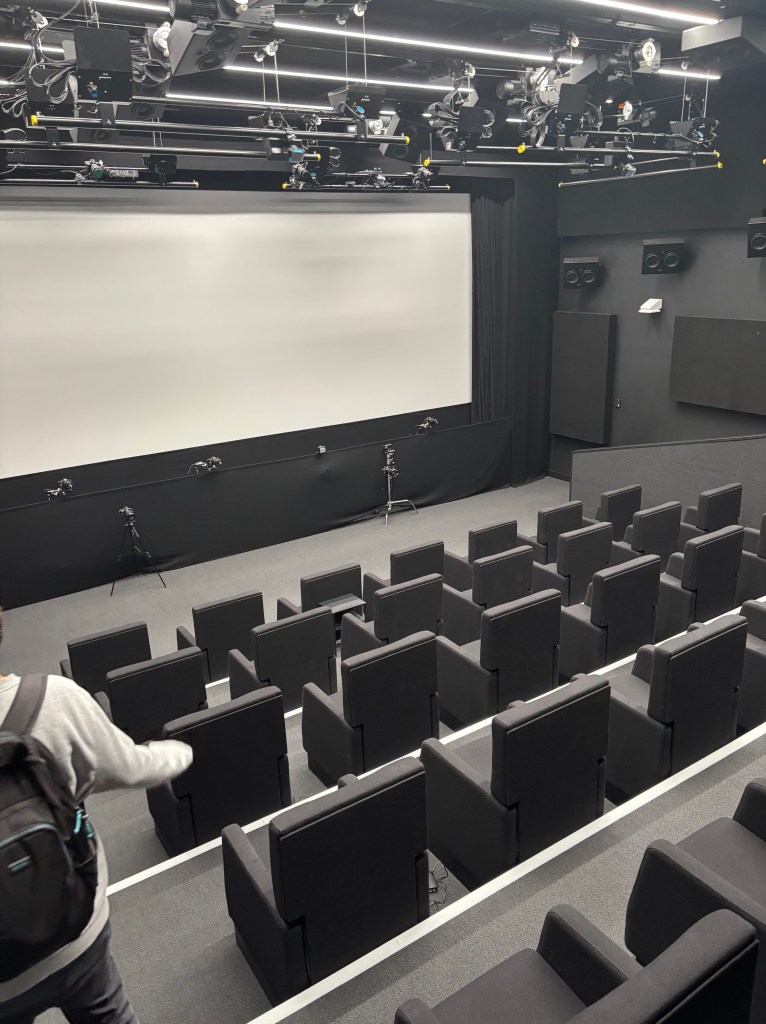
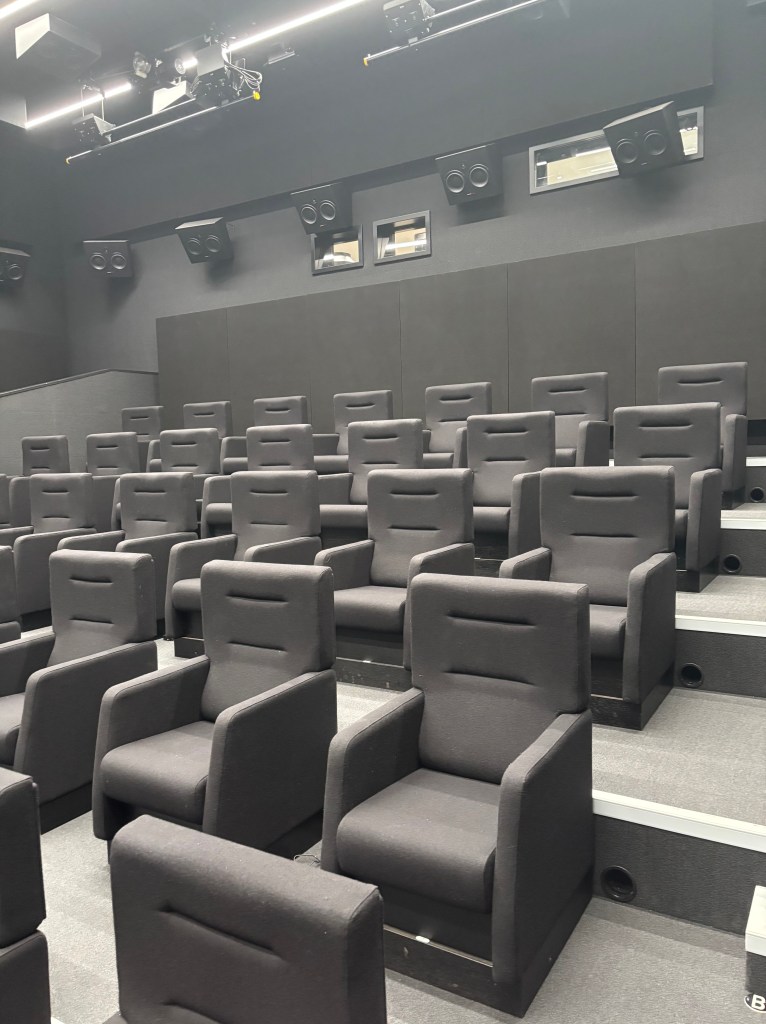
    Nixon’s perspective shed a completely different light on what I saw at the workplaces I visited. Paolo Russo at Oxford Brookes University showed me around the campus, showed me the facilities, and we briefly discussed the technology available to their students. With Murray Smith at the University of Kent, we discussed his recent experience with interdisciplinary research and its applicability in teaching. Ceylin Ertekin from the London School of Economics showed me around their eye-tracking lab. Deborah Klika from the University of Greenwich gave me a tour of their studios, including virtual production. And everywhere I went, I thought to myself that it would take us a very long time to catch up in Czech film and humanities departments in general.

    Nixon’s book puts this into a different perspective. Thanks to smartphones, we all have a camera in our pocket (in new iPhones, even with an eye tracker). Thanks to TikTok and YouTube, we all have access to a global audience. The democratization of technology may have completely redrawn the field in which we operate. The best Hollywood producers are suddenly meeting amateurs, and gatekeepers are losing power.

    Don’t get me wrong. I still think technology is essential. The fact that Royal Holloway and the University of Greenwich have virtual production studios means that they have enormous opportunities in terms of research. The excellent sound technology at Oxford Brookes University offers unparalleled opportunities for their students, even if they use it to shoot on their phones. But if we stick to the educational dimension and student expectations, Nixon is probably right and access to the latest technology is not essential. After all, the best films are already being made for TikTok.

    For me, Nixon’s book is mainly an inspiration to rethink what film studies are for and what their place is in today’s education system.

    • About SNAPlab
    • Books, chapters, articles
    • From the Lab
    • Lectures, Presentations, Conferences
    • Teaching
    • Tools
    • Uncategorized

    December 11, 2025
    film schools, Teaching, technology, tiktok

  • How does the aspect ration affect viewers?

    After almost a year, I was teaching students again. I was lucky that the Department of Theater and Film Studies gave me the opportunity to teach almost anything, so I was able to talk about my current research. Specifically, I decided to discuss with students the significance of the frame of a moving image.

    Looking back, I don’t think I was ever particularly interested in the frame of a film. Of course, I was aware of pan-and-scan editing of films for television and VHS, but since I had been using the internet since childhood, it didn’t bother me that much. It was more of an trivia from history of cinema.

    That changed, of course, with vertical short videos. If we look at the statistics, today’s TikTok users in Czechia watch an average of over an hour of videos in vertical format every day. That’s hundreds and hundreds of scenes, short stories, or just recordings of something.

    In other words, today the frame of the film image is an essential topic. And that’s why I wanted to devote a seminar to it.

    We started with a discussion of literature (Eisenstein: The Dynamic Square and Somaini: The Screen as “Battleground”: Eisenstein’s “Dynamic Square” and the Plasticity of the Projection Format) to raise awareness that the horizontal shape of the film frame was not always a given. The students then worked in groups to analyze several films that creatively manipulate the aspect ratio of the image. These included The Door in the Wall (1956), The Grand Budapest Hotel (2014), X (2022), films by Ola Røyseland, and a selection of TikTok videos.

    The culmination of the course was for students to work in small groups to shoot their own short film in which they tried to use the frame to influence the audience. To test whether they succeeded in their intention or not, each group had to write a hypothesis and email it to me before the final screening. In the discussion after the screening, I then tried to find out whether the authors’ intention was successful or not. 

    In my opinion, the course was a success. It seemed to me that the students used the knowledge they had gained from reading and analysis in their own work. And the resulting films turned out very well, even though the students only had one day to make them.

    With their permission, I am presenting the films here.

    Team 1 (Březnická, Raiskaia, Karim)

    The students achieved something unprecedented in this video. Their intention was, of course, for the colored rectangles to draw the viewers’ attention. However, I noticed that after the first rectangle appeared relatively far from the center of the image, I tended to look around the edges of the image to see if there were any other colored rectangles. I had the impression that the students had managed to break the center bias that movie viewers naturally gravitate toward and that filmmakers take advantage of.

    Team 2 (Podlaha, Hampeisová, Prajslerová, Ryšanková)

    It was probably the most ambitious film in the class. Those of you who watched the video on your smartphone—did you turn your phone around? If so, you fulfilled the filmmakers’ intention.

    In the discussion after the screening, I repeatedly heard that it was the moment when the character was upside down that made them turn their phones. Whatever the moment, it shows us that watching audiovisual content on a smartphone can count and deliberately elicit active audience engagement that would have been unthinkable in a cinema.

    Team 3 (Mührová, Tkadlecová, Moskvina)

    The students attempted to assign different perceptions of time to different aspect ratios. Can you guess which aspect ration was supposed to represent hecticness? Probably yes. In any case, I assume that they did not rely solely on the aspect ratio, but also supported the state of being busy with movement, colors, and tripling the videos.

    Team 4 (Salvadori, Mičola, Romsy)

    In this film, the students devoted themselves to narration more than any other group. Working with the frame therefore does not come to the fore as it does in other pieces; it does not draw attention to itself. The frame of the image strives to be an organic part of the whole.

    Team 5 (Cvrkalová, Kalianková, Kožárová )

    The last group tried to create an impression of paranoia and surveillance in the audience. Judging by the reaction of their classmates, they were the only ones who didn’t succeed. I wondered why that was. The reason could be the short length of the film or the violation of certain editing techniques (e.g., the absence of a POV shot after a close-up of the face). Despite the fact that the students in team 5 did not succeed in fulfilling their intention, it was fascinating to see how they approached the task.

    • About SNAPlab
    • Books, chapters, articles
    • From the Lab
    • Lectures, Presentations, Conferences
    • Teaching
    • Tools
    • Uncategorized

    November 18, 2025
    aspect ratio, cinema, film, film studies, filmmaking, movies, vertical frame

  • ZIP-SCENE Conference II.

    The second day of the conference had one clear highlight for me—Ola Røyseland‘s presentation. His contribution was called Frame/less, and I was surprised by how close his thoughts were to mine. Ola is a filmmaker who focuses on shooting short films in his doctoral thesis. He draws on two assumptions: 1. we watch films because they convey emotions to us through narration, 2. VR is associated with a lack of emotion and weak narration. His goal is to identify which formal techniques are suitable for storytelling in VR. To achieve this, he shoots each of his films in two different formats—classic film and 180 degrees. He then tests his films on audiences to find out what works and what doesn’t.

    Olovy’s films are short, entertaining, and experiment with things such as narrative perspective and point of view.

    I was thrilled by Ola’s presentation. He demonstrated exactly the kind of thinking that interests me in filmmakers and managed to formulate it as a research problem that he addresses in his work. I sincerely hope that this was not my last encounter with Ola.

    I was also intrigued by Lukáš Hejtmánek‘s presentation on multisensory perception. Although it is relatively distant from my topic, I enjoyed the playfulness with which they carried out their experiment. In short, it was about verifying what sensory stimuli need to be simulated in order for a visit to the forest in VR to have a therapeutic effect. Surprisingly, artificial grass underfoot and aroma lamps are not necessary. Apparently, visual and auditory stimuli are enough.

    The next day, I also realized that another great contributions by Oliver Kobián and Pavel Srp (yesterday) had something in common: both studied under Lukáš Hejtmánek.

    I also found Marika Hedemyr‘s contribution extremely inspiring. She talked about her mixed reality project. At one point, she emphasized the importance of pauses in directing the attention of people participating in her project. She deliberately placed pauses after significant sentences in the audio guide’s speech (e.g., questions). She determined the length of the pauses intuitively, but not at first glance, and from what she showed us, the pauses lasted from a few to tens of seconds. 

    And that was the ZIP-Scene Conference for me. I don’t know if the organizers will want to invite me back next year, but I will definitely want to come.

    • About SNAPlab
    • Books, chapters, articles
    • From the Lab
    • Lectures, Presentations, Conferences
    • Teaching
    • Tools
    • Uncategorized

    October 25, 2025
    180 degrees, film, film form, movies, multisensory, VR

  • ZIP-SCENE Conference I.

    Today and tomorrow, I am attending the ZIP-SCENE Conference in Prague. The conference is part of the Art*VR Festival at the DOX Center for Contemporary Art.

    When I saw the program, I was surprised that my proposal was accepted at all. Most of the presentations are about VR, XR, video games, etc. So my 2D vertical videos stand out a bit. I tried to choose a framing that placed the viewing of vertical videos in the context of the audiovisual landscape, which also includes VR. Some colleagues certainly noticed this, but they were kind enough to keep their doubts about compatibility to themselves.

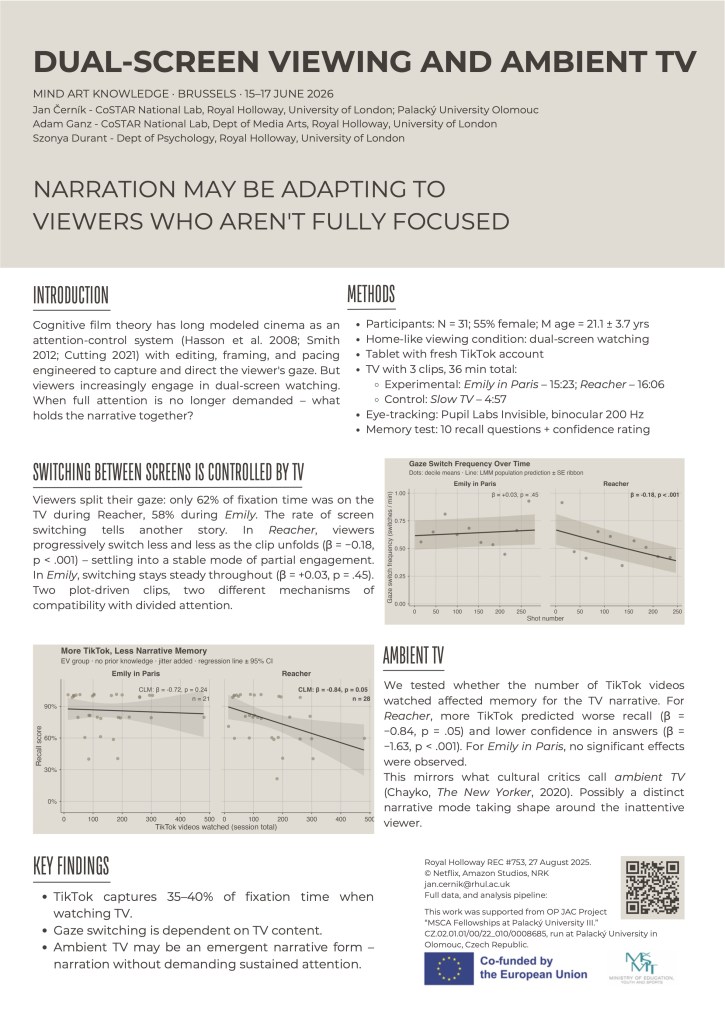
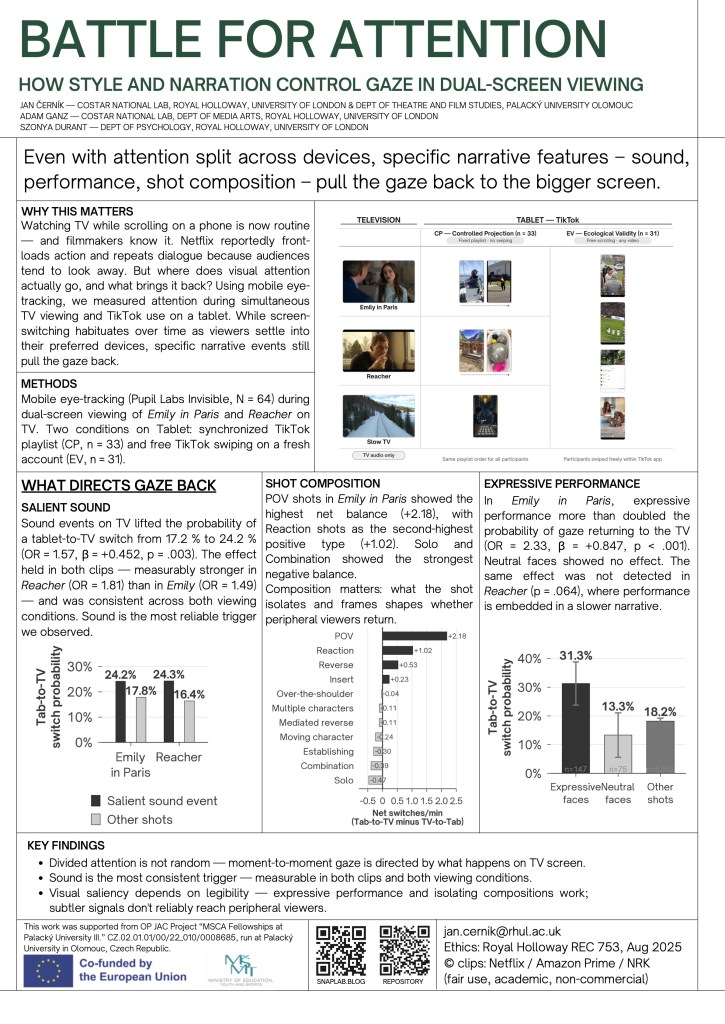
    On the contrary, I received positive feedback, and the main finding that vertical framing causes fragmented viewing surprised several colleagues. (I would like to write more here, but only after we publish it in an article we are preparing with Szonya Durant and Adam Ganz).

    Nevertheless, from the other contributions, I had the impression that I had found a similarly minded audience. The ZIP-SCENE Conference is a great achievement by Ágnes Karolina Bakk‘s team. This is already the seventh year, and they have succeeded in bringing together artists and researchers from various fields who think not only about what they create, but also about how it affects the audience.

    I was most interested in the following presentations:

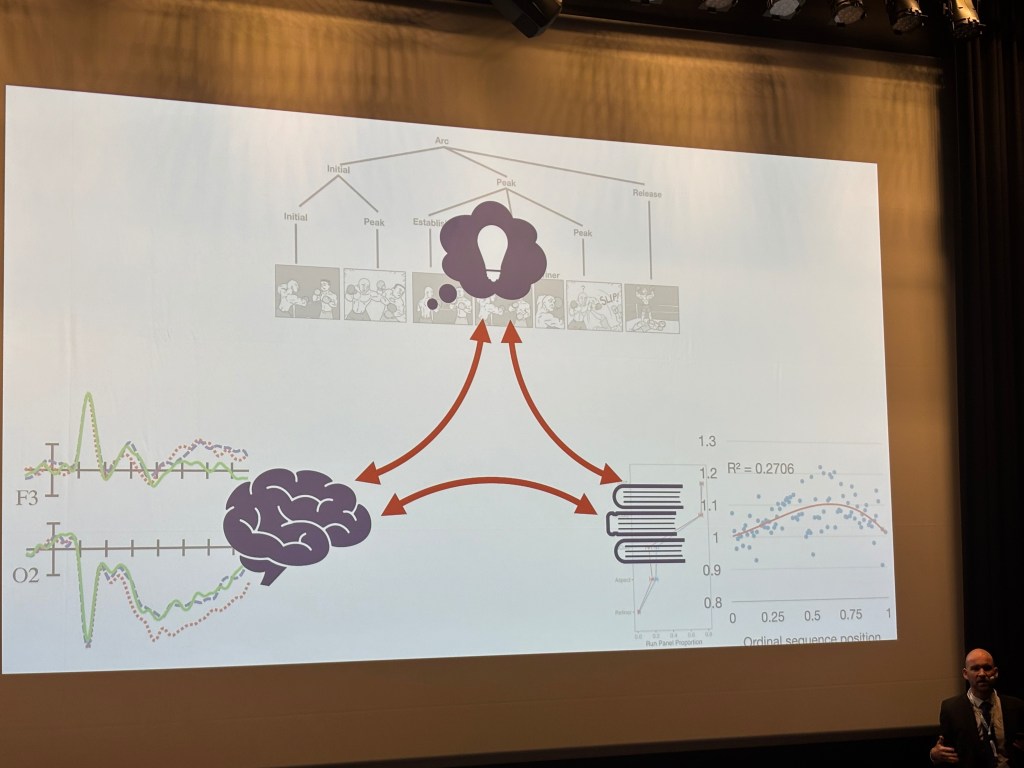
    Niels Erik Raursø presented the research activities of the Augmented Performance Lab at Aalborg University in Denmark. They are investigating how to use EEG to analyze audience responses to storytelling. In theory, this could lead to greater personalization of storytelling for the needs of individual viewers in the future. I would probably need to hear more about their research, because in this 15-minute presentation I identified some methodological problems. For example, I think they could easily fall into the trap of choosing the wrong way to segment the narrative. In any case, I found Niels’ research extremely inspiring.

    Another thought-provoking presentation was by Felix Carter, Iain Glichrist, and Danae Stanton-Frasert. They experimentally explored how a change in the narrative affects the audience’s attention towards exogenous cues. In my opinion, their research potentially shows how big a difference there can be in how we understand films. Not that we encounter different editing of films in cinemas (although that is also possible). I am referring to the simple fact that not all of us pay full attention to films throughout their duration. We look at our mobile phones while watching a film, we go to the fridge or the toilet, we talk to people around us, and films on TV are interrupted by commercials.

    The last contribution I want to mention from today’s program was presented by Pavel Srp. He talked about an experiment in which they tested whether a linear or logarithmic function is more suitable for determining the distance of a sound source in relation to volume. The conclusion was that a logarithmic function is more suitable. Pavel’s paper is the third I have heard at the conference in a short time from “sound people,” and all three were excellent and provided great insight into audience perception.

    And since I was at the Art*VR festival, I wanted to try out what it’s like to be in virtual reality. In short, after five minutes I felt sick and it took me about an hour to recover. But tomorrow I’ll give VR another chance.

    • About SNAPlab
    • Books, chapters, articles
    • From the Lab
    • Lectures, Presentations, Conferences
    • Teaching
    • Tools
    • Uncategorized

    October 23, 2025
    art, storytelling, technology, VR

  • There’s nothing on TV

    Imagine this situation: You come home from work in the evening. You’re tired, so all you can manage is to watch a movie. You can’t find anything to watch on Netflix, so you turn on the new AI platform, which creates a movie tailored to your current needs. It chats with you for a while, finds out your mood and preferences, and after a moment, creates a movie just for you.

    Do you like that idea? I quite do. However, according to Mark Zilberman, we will have to wait at least another ten years for this to happen.

    In a published pre-print article, he claims that with current computing capacity, 100 graphics cards would be needed to generate 30 frames per second.

    “Modern diffusion-based image models for high-resolution images (e.g., 1024×1024 px, 30–50 diffusion steps) require on the order of 50–100 TFLOPS to generate a single frame.

    – For real-time video (30 fps, 3600 seconds) the total number of frames is 108,000.

    – Naive estimate without optimizations: 100 TFLOPS × 30 fps ≈ 3,000 TFLOPS (3 PFLOPS) of sustained compute. This is equivalent to hundreds of top-tier GPUs such as the NVIDIA H100.”

    I cannot myself verify whether Mark’s calculations are correct. When I consulted Perplexity, it found several errors in Mark’s argument. These were mainly: a) overestimation of the processing power of graphics cards, b) simplification of the video generation process, c) omission of the possibilities for optimizing the video generation process. However, the result is the same, and even according to Perplexity, home video generation (i.e., on a single graphics card) can be expected only in the second half of the 2030s.

    If that day were today, I would have the fourth installment of Naked Gun with Leslie Nielsen generated.

    • About SNAPlab
    • Books, chapters, articles
    • From the Lab
    • Lectures, Presentations, Conferences
    • Teaching
    • Tools
    • Uncategorized

    October 16, 2025
    ai, film

  • Film Archives as an Unforeseen Ally of Generative AI

    In recent weeks, the boom in generative AI models has begun to shift from text and images to video. Anyone can create an eight-second video using Google’s Veo model. Open AI has announced the launch (currently only in North America and by invitation) of a video platform running on the Sora 2 model. In addition, other platforms are emerging that enable the generation of special forms of content, such as micro dramas.

    In our family, video generation has become part of our daily bedtime routine. Every evening, the children simply dictate to me what they want their fairy tale to be about. Gemini first prepares the text for me, and after I finish reading it, we generate the video. I consider this to be one of the greatest advantages of generative AI, as the quality of the fairy tales does not depend on how tired I am.

    The problem, of course, is that eight-second videos created in two minutes enchant us now, but in a moment we will consider them the norm and they will no longer be enough for us. And if I understand correctly, the problem for developers is still to keep the characters looking consistent between shots, or to ensure that the resulting videos follow basic cinematic continuity rules. This is not surprising, because AI must first learn to tell stories like filmmakers in order to match them, and it took filmmakers decades to do so. And developers could be helped by a traditional institution well known to film historians – the archive – with its tried and tested rules of film storytelling.

    I realized this in connection with The Development of Generative Artificial Intelligence from a Copyright Perspective from May 2025, which was brought to my attention by my friend and lawyer Miroslav Obernauer. The creation of a license for training generative AI is being considered. This would solve the problem of the need to train AI on existing works on the one hand and copyright protection on the other.

    And this is where there is room for film archives to become centers for training AI, in addition to their role of preservation, restoration, and dissemination.

    Take, for example, the Národní filmový archiv in Prague. Archivists care for hundreds of films made in Czechoslovakia – films that could be used to train generative AI. And their collections include thousands more films from other countries around the world. 

    Of course, I don’t know if this will happen. But I like the idea that an institution such as an archive, which – let’s be honest – is not one of the driving forces behind the digital revolution and does not exactly come across as cool to the public, could find a new role and become integral part of the creation of modern technologies.

    • About SNAPlab
    • Books, chapters, articles
    • From the Lab
    • Lectures, Presentations, Conferences
    • Teaching
    • Tools
    • Uncategorized

    October 6, 2025
    ai, archive, artificial-intelligence, cinematic continuity, film archive, technology

  • SRN Conference 2025 IV.

    The last day of the conference had two highlights for me.

    The first highlight was a reading from Deborah Klika’s screenplay Czech in the Rear View Mirror. I have known Deborah since 2023 and I know that she is proud of her Czech roots. Her screenplay is the story of her parents, who emigrated to Australia. The table read of the script was a great experience, partly because it was funny, but mainly because Deborah found Czechs living in Adelaide to play the two main characters. In addition, two other ladies from the Czech club in Adelaide came to the reading. After the reading, I had the opportunity to talk to them and it was nice to hear their stories, in varying degrees of Czech language recall.

    The second highlight of the day was a presentation by Alicia Butterworth. Alicia is a sound designer and she talked about how they developed and created the VR experience We Were Children Once about Holocaust survivors. I consider it the best paper of the entire conference. Alicia was able to introduce us to the details of a sound designer’s work in preparing VR and concluded her talk with a set of recommendations for VR creators. Among the recommendations were the following regarding directing the audience’s attention in 360 degrees:

    – Involve sound from pre-prod – we can help direct attention.

    – VR is overwhelming for the audience – attention cues need to be significantly more obvious (louder/more present) to affect the audience than in traditional disciplines.

    Sound designers therefore think about attention quite consciously. This reminded me of James Cutting’s observation that filmmakers are great psychologists. This is probably even more true of sound designers. There were two contributions from sound designers at the conference, and both showed that they think about audiences quite differently from screenwriters. From screenwriters at the conference, I heard mainly reflections on the diversity of audiences and the impossibility of generalizing about them. Sound designers approach this from the opposite angle—from perception—and thus have a quite different idea of audiences based on shared sensory experience.

    That’s all from this year’s conference, and see you next time in Oxford!

    • About SNAPlab
    • Books, chapters, articles
    • From the Lab
    • Lectures, Presentations, Conferences
    • Teaching
    • Tools
    • Uncategorized

    September 20, 2025
    attention, screenwriting, sound, sound designers, table read, VR

  • SRN Conference 2025 III.

    Another conference day in Adelaide. This time, I decided to skip one panel to get into town. I had planned my visit to Australia—my first—very short, and I was sorry to spend it only in conference halls. I walked through part of the city center and took a short stroll through the park and botanical gardens.

    In the morning, I attended a panel discussion on the role of sound in writing. The panel focused mainly on teaching methods, and Elisabeth Monge, Anne Regine Klovholt, and Ben Slater talked about how sound and recordings are used in teaching screenwriting students. I liked how Elisabeth and Anne Regine showed us how they guide students in thinking about sounds. Storytelling and interpretation are preceded by simply labelling the sounds we hear. On the other hand, when working with sounds in text, they believe that it makes no sense to just describe the sounds, but rather to explain their function. I think this demonstrated the importance of sound and how authors think about it in detail and need to have more control over it than over visuals.

    In the next panel, I was intrigued by Sylvie Jane Husebye’s research project. The whole time, I kept thinking that her approach reminded me of Warren Buckland. Then I learned that she is Warren’s student. Sylvie analyzes narratives, focusing on gaps in the plot. She works on the assumption that gaps in the narrative can be quantified and that storytelling patterns can be traced based on the changing number of gaps. According to her, this could help screenwriters when thinking about their narratives. It looks like a massive project that works with a lot of empirical data, which I like.

    Between panels, I had the opportunity to talk to Steven Maras about film viewing. We probably don’t agree on a lot of thinks, but we gradually came to the conclusion that the models of viewers, as theorists conceive them, are often very idealistic (Steve would say “mentalist”). In my opinion, the way to remedy this is through cognitive and empirical research. Steven sees it quite the opposite and blames David Bordwell and the cognitive tradition for how schematically theorists think about audiences.

    I wonder what the results of a survey among screenwriters, directors, producers, sound designers, film theorists, archivists, and projectionists would be if they were asked to describe how they think about audiences…

    • About SNAPlab
    • Books, chapters, articles
    • From the Lab
    • Lectures, Presentations, Conferences
    • Teaching
    • Tools
    • Uncategorized

    September 19, 2025
    audience, screenwriting, sound, Teaching

  • SRN conference 2025 II.

    Second day in Adelaide. I skipped the morning panel and prepared for my presentation.

    Despite careful preparation, it didn’t work out for me this time. I talked about my postdoctoral research. I briefly described the experiment we did and tried to show how some elements of working with the audience’s attention, which can already be found in the scripts, even though they work in landscape format, change their effectiveness in directing attention when cropped to portrait format. Sometimes they are lost and sometimes they gain strength. In my opinion, depth of field was a stylistic device that, based on a qualitative comparison of data visualizations from the eye tracker, seemed to me to be more effective in maintaining attention when it was in portrait format. I will try to rework the lecture into an article and express it in a different way.

    Karreen Ely-Harper immediately responded to my presentation with a comment. She first questioned eye tracking and emphasized the diversity of the viewing experience. I encountered a similar opinion later in the foyer. Strange. I didn’t really understand what bothered them. When I had the opportunity to talk to Karreen again later, I found that we agreed on many things. We both think that the vertical format requires a different approach from filmmakers, and we both agree that it requires a different approach to writing—more focused on space and position in the frame. And we both suspect that TikTok could influence how people think about narrative segmentation. We may disagree on the details, but I was glad that we found common ground for discussion and perhaps even future collaboration.

    The discussion with Karreen was very enriching for me. She came up with the claim that it makes no sense for young filmmakers to strive to make a short film. It is much easier and more effective for their careers to make a micro-drama or a short video for TikTok. It’s cheap, fast, and it doesn’t hurt so much when mistakes are made. 

    What else did I see at the conference?

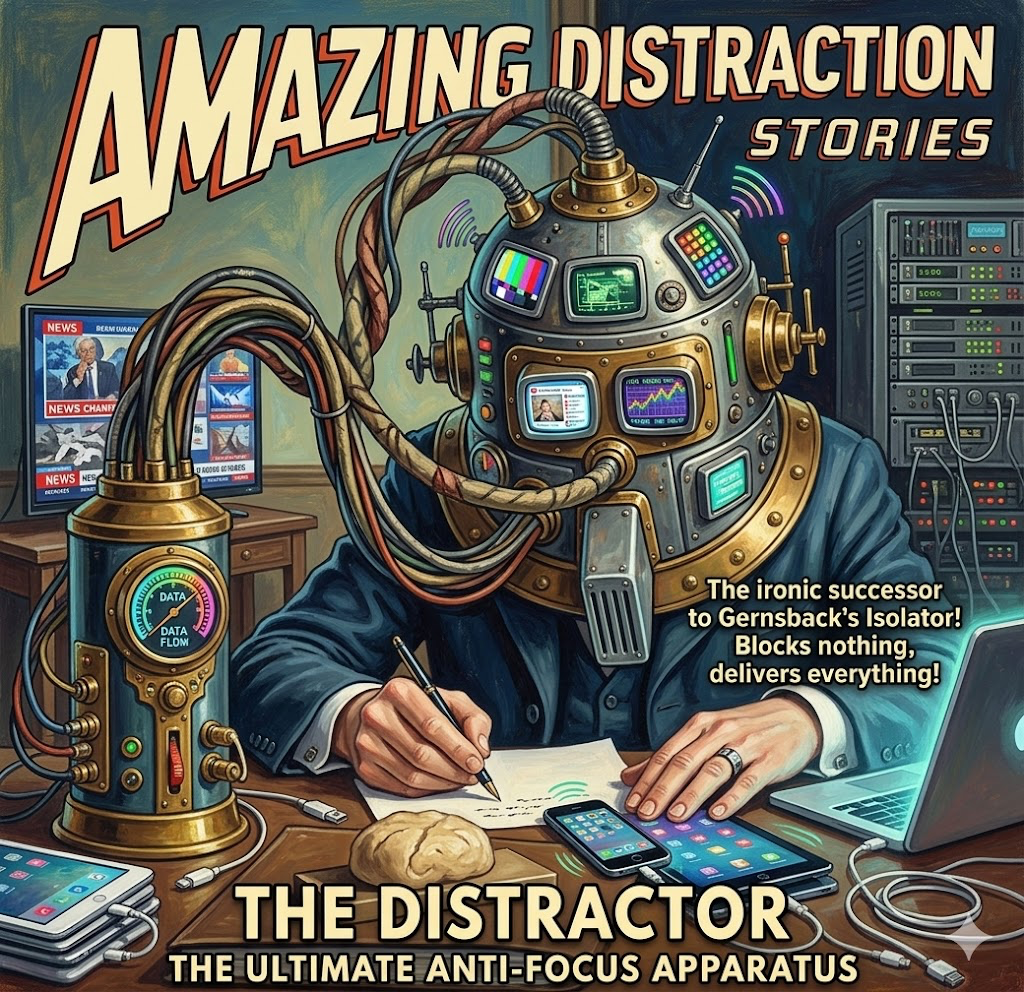
    I was on the panel with Brett Davies, who talked about Steven Spielberg’s television work. Yes, that’s how compatible our papers were. Apparently, the other speakers dropped out of Brett’s and my panel, so we were left on our own. But I didn’t mind. Brett talked about Spielberg’s series Amazing Stories, which I hadn’t had a chance to see and which made me quite curious. 

    I also attended a panel on feminism and comedy-drama, featuring Deborah Klika, Susan Cake, Marilyn Leder, and Joanne Tindale. All of them are screenwriters who aspire to reflect their approach to their work. It was interesting to see the role theory has in their work. This was most evident in Joanne’s case. She took theoretical knowledge about the representation of aging women in films and used it to formulate principles that she herself wants to adhere to when writing characters. I don’t know if it will work, but in any case, that’s what I enjoy about the SRN conference—seeing how filmmakers think.

    At the end of the day, I attended a screening of Elenydd (2025, Richard O’Sullivan). Before the screening, the author gave a lecture explaining his concept. I am probably too simple-minded to fully understand the continental philosophy of embodied ways of seeing the landscape. But something else caught my attention in the film itself. Most of it consisted of quite nice extreme long shots/establishing shots of the Welsh landscape. However, I noticed that in some shots I had the impression that I didn’t know where to look. It’s hard to say if that was Richard’s intention, but sometimes the shot seemed to lack a salient element. Most of the shots had it approximately in the center of the composition. But a few shots lacked such an element. It would be interesting to test whether others struggle to identify the salient element in the same shots as I do.

    That’s all from the second day of the conference.

    • About SNAPlab
    • Books, chapters, articles
    • From the Lab
    • Lectures, Presentations, Conferences
    • Teaching
    • Tools
    • Uncategorized

    September 19, 2025
    feminism, film, landscape, micro-dramas, short video, writing

  • SRN conference 2025 I.

    As is now tradition, I am participating in the Screenwriting Research Network in September. This time in Adelaide at the University of South Australia. Although I am gradually moving away from screenwriting as a research topic, I enjoy attending this event. Every year, I enjoy the exchange of experiences between academics and screenwriters and the reflections of screenwriting teachers on the education of new writers.

    For me, the beginning of the conference is marked mainly by a twenty-hour flight. Not that it’s wasted time, but I’m just exhausted. On the plane, I managed to watch the film El Ankaboot (2022, Ahmad Nader Galal). I was thinking about watching something else, but in the end I couldn’t resist and went for the selection of Arabic films. Two things in particular caught my attention in the film:

    1. Everywhere, the premise of the film is advertised as follows:

    An action thriller that revolves around a dangerous drug dealer, who is able to manufacture new drugs and sells them but falls into many problems and is chased by the police.

    Either I didn’t understand the film, or this is the synopsis for a different film. 

    2. Almost every time female characters appeared in a scene, it felt like the genre was changing (conversational comedy, romantic film, relationship drama…). 

    In addition, there were several narratively interesting moments when the perspectives of several characters intertwined. Also, I felt that I sometimes got lost in the dialogues because I missed some cultural specifics.

    Anyway, I really enjoyed it.

    Today’s conference program had only one item on the agenda: a discussion with local film director and screenwriter Sophie Hyde, whose film Jimpa premiered at Sundance this year. Most of the debate focused on her writing process, which is understandable given the event. But I was intrigued when she talked about how difficult it is for Australians to break into the American market. I would never have thought so, considering all the Australian actors and musicians. But then Rosanne Welch, an American and chair of the Screenwriting Research Network, confirmed this to me in the foyer. 

    Anyway, I’m going to bed because I have my paper tomorrow.

    • About SNAPlab
    • Books, chapters, articles
    • From the Lab
    • Lectures, Presentations, Conferences
    • Teaching
    • Tools
    • Uncategorized

    September 17, 2025
    conference, screenwriting

Next Page
  • About SNAPlab
  • Books, chapters, articles
  • From the Lab
  • Lectures, Presentations, Conferences
  • Teaching
  • Tools
  • Uncategorized

This work was supported from OP JAC Project “MSCA Fellowships at Palacký University III.” CZ.02.01.01/00/22_010/0008685, run at Palacký University in Olomouc, Czech Republic. 

Blog at WordPress.com.


Loading Comments...
 

    • Subscribe Subscribed
      • SNAPlab
      • Already have a WordPress.com account? Log in now.
      • SNAPlab
      • Subscribe Subscribed
      • Sign up
      • Log in
      • Report this content
      • View site in Reader
      • Manage subscriptions
      • Collapse this bar